 Português

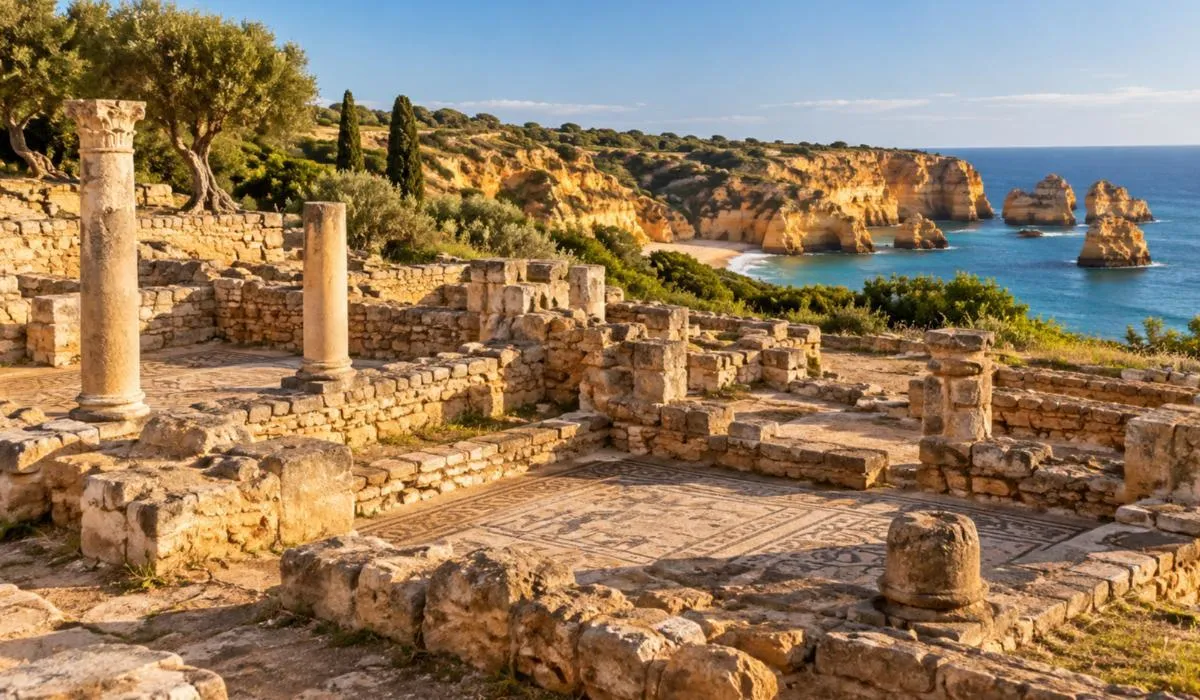
Lagos and the western Algarve hold thousands of years of human history in the ground. Within a short drive you can stand before Neolithic menhirs raised five thousand years ago, trace the walls of a Roman fish-salting villa, or confront one of the most significant — and sobering — discoveries of the transatlantic slave trade. Here are ten archaeological sites worth seeking out, and what each reveals.
1 Monte Molião
On a hill overlooking the Bensafrim estuary just outside the old town, Monte Molião is one of Lagos's most important archaeological sites. Inhabited from the Iron Age through Roman times, it was part of ancient Lacobriga, and excavations have revealed houses, walls, baths and a wealth of finds. The site is fenced and not formally open, but you can see the remains from the perimeter — and the view alone tells you why people settled here.
2 Cemitério de Escravos do Vale da Gafaria
In 2009, building work just outside the 16th-century town walls uncovered one of the most poignant archaeological finds in Europe: a refuse pit where the bodies of around 155 enslaved Africans — men, women and children — had been discarded between the 15th and 17th centuries, outside all burial customs. It is the oldest known burial place of enslaved Africans in the world. The site itself was built over, but its story and the remains are presented with care at the Rota da Escravatura museum nearby (see below).
3 Núcleo da Rota da Escravatura (Mercado de Escravos)
Housed in the old market building on the main square — itself thought to be the site of the first slave market in Europe — this small but powerful museum tells the story of Lagos and the transatlantic slave trade, and displays the finds from the Vale da Gafaria cemetery. It is a sobering, essential visit, and the most direct way to understand this chapter of the town's history. Entry is modest, around 3 euros.
4 Museu de Lagos (Dr. José Formosinho)
Lagos's municipal museum is the place to see the region's archaeology gathered under one roof. Its eclectic collection ranges from prehistoric and Roman artefacts to local history, ceramics and a famous "cabinet of curiosities," with finds from sites across the area. It's a great companion to visiting the sites themselves, putting the scattered remains into context. The dazzling gilded church of Santo António is part of the same visit.
5 Menir de Odiáxere
In the village of Odiáxere, in the garden of Quinta Menir, stands a Neolithic standing stone several thousand years old. Cylindrical with a broken top, it is decorated with wavy lines carved in relief — and flint tools and pottery found nearby suggest a prehistoric settlement once stood here. A quiet, easily reached monument, and a tangible link to the area's earliest inhabitants.
6 Menir da Cabeça do Rochedo
Near Bensafrim, a short walk from the road leads to this striking Neolithic menhir, notable for a spiral motif carved into its surface thousands of years ago. Standing alone in the open countryside, it's a remarkably accessible glimpse of deep prehistory — and the kind of monument that rewards anyone willing to seek it out. Wear sturdy shoes for the short climb.
7 Menires do Padrão
Out towards Vila do Bispo lies one of the Algarve's richest concentrations of standing stones. The Padrão group includes around a dozen menhirs, some excavated by archaeologists, dating to the late Neolithic and early Chalcolithic — roughly 5,000 years ago. Scattered across the open landscape near the wild south-west coast, they form part of a remarkable prehistoric ritual landscape.
8 Cromeleque dos Amantes
Even rarer than a lone menhir is a cromlech — a circle of standing stones — and near Vila do Bispo you'll find one. The Cromeleque dos Amantes is made up of menhirs of white limestone arranged in an ellipse, set in quiet countryside a short distance from the village. These megalithic enclosures held deep ritual meaning for the communities that raised them, and standing among the stones is genuinely atmospheric.
9 Ruínas Romanas da Boca do Rio
On the beach at Boca do Rio, west of Lagos, the remains of a Roman villa and fish-salting complex sit right at the water's edge — some of it slowly eroding into the sea. This was once a thriving production site, salting fish and making the prized garum sauce traded across the empire. There are no information boards, and archaeologists still work here, but the visible walls and tanks make for an evocative, off-the-beaten-track stop.
10 Villa Romana da Abicada
Near Mexilhoeira Grande, east of Lagos, the Villa Romana da Abicada is the remains of a grand Roman residence laid out around a peristyle courtyard, once decorated with mosaics. It dates from the early centuries AD and sits in a peaceful rural setting near the Alvor estuary. It is not formally open and is unsignposted, so it's one for the dedicated — but it completes the picture of Roman life along this coast.
Visiting the sites
Most of these sites are outdoors and free, and the two museums in town are inexpensive. Several of the prehistoric monuments are unsignposted and reached on foot, so wear good shoes and tread carefully — these are fragile places thousands of years old. Please don't climb on or touch the stones; they have survived millennia, and deserve to survive many more.
Frequently asked questions
What is the Mercado de Escravos in Lagos?
A building on the main square thought to be the site of the first slave market in Europe. Today it houses the Núcleo da Rota da Escravatura, a small museum on Lagos and the transatlantic slave trade, with an entry fee of around 3 euros.
What was found at Vale da Gafaria?
In 2009, building work just outside the 16th-century town walls uncovered the remains of around 155 enslaved Africans, discarded in a refuse pit between the 15th and 17th centuries. It is the oldest known burial place of enslaved Africans in the world, and its story is told at the Núcleo da Rota da Escravatura.
Are there menhirs near Lagos?
Yes. The Odiáxere menhir, in the garden of Quinta Menir, and the Cabeça do Rochedo menhir near Bensafrim, carved with a spiral. Out towards Vila do Bispo are the Menires do Padrão, a group of around a dozen stones, and the Cromeleque dos Amantes.
What Roman remains can you see near Lagos?
The ruins at Boca do Rio, west of Lagos, a Roman villa and fish-salting complex at the water's edge where garum was also made, and the Villa Romana da Abicada near Mexilhoeira Grande, which is not formally open and is unsignposted.
Are the archaeological sites near Lagos free?
Most are outdoors and free, and the two museums in town are inexpensive. Several prehistoric monuments are unsignposted and reached on foot: wear good shoes and do not climb on or touch the stones.

