 Português
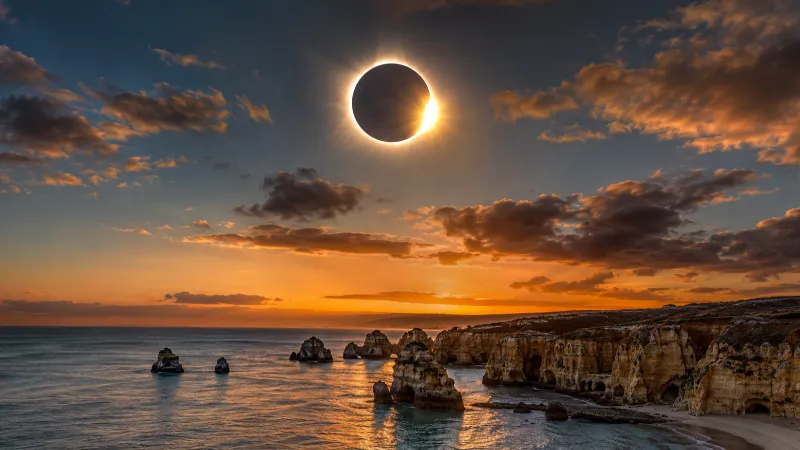
Top 10: The Best Places in Lagos to Watch the Solar Eclipse of 12 August 2026
The greatest solar eclipse visible from Lagos in over a century happens in the late afternoon of 12 August 2026 — and the secret to seeing it well is simple: a completely open western horizon.
On 12 August 2026, in the late afternoon, the Moon covers 92 to 93% of the Sun's disc as seen from Lagos — the deepest eclipse visible from here since 1912, and the last of this magnitude most of us will ever see from Algarve soil. It is not a total eclipse (totality only touches Portugal at one remote spot in Trás-os-Montes), but it is a rare spectacle with one feature that makes it unique: it happens with the Sun very low, almost touching the horizon. The eclipse and the sunset share the same window.
Timings in Lagos: the partial phase begins at 6:33 pm, maximum is around 7:30 pm (with the Sun about 10° above the horizon, almost due west), and it ends at 8:24 pm, just before sunset.
This changes everything about choosing where to watch. Lagos's most famous beaches — Dona Ana, Camilo, Estudantes — face east and will be in the shade of their own cliffs at that hour. For this eclipse, what counts is an unobstructed western horizon, ideally over the sea. These are our ten.
1. Ponta da Piedade — lighthouse area
The most obvious spot and the best one: high cliffs, an open sea horizon from south to west, nothing between you and the Sun. Arrive very early — this will be the busiest place in town — and don't count on parking after 6 pm.
2. Ponta da Piedade boardwalks
The wooden boardwalks between the Canavial area and the lighthouse — all sections are open — offer dozens of west-facing spots and spread the crowd far better than the main viewpoint.
3. Praia do Canavial viewpoint
On the clifftop, along the western stretch of the boardwalks: a wide view over the coast and the open sea to the west. It's the quieter alternative to the lighthouse, without going down to the beach — at nightfall, enclosed coves are no place to be.
4. Clifftop above Praia do Porto de Mós (western side)
The beach itself is boxed in, but the clifftop on its western side has a clear view over the sea to the west. Leave the car at the beach car park or in the nearest residential area and walk the rest of the way along the trail.
5. Atalaia and Rocha Negra — via the Fishermen's Trail
The classic climb: from the eastern end of Praia da Luz, the trail (stage 13 of the Rota Vicentina) climbs in about 15 minutes to the Atalaia geodesic marker, the highest point between Luz and Porto de Mós, passing above the dark headland of Rocha Negra. The altitude beats any low haze on the horizon — in an event where the Sun sits at 10°, every metre of elevation counts. Bring proper footwear and a torch for the way down.
6. Meia Praia — eastern end
Counterintuitive but effective: from the final stretch of the beach, beyond the Meia Praia railway halt towards the mouth of the Ria de Alvor, looking west takes your eye across the bay over a low, clean horizon — with the silhouette of the town and Ponta da Piedade in the foreground. Lagos's own Ciência Viva Science Centre points to this area as a viewing alternative. Probably the best photograph "with Lagos in it", and parking is far easier than at Ponta da Piedade.
7. Marina area — the town-centre option, on foot
For anyone in the historic centre without a car: the riverside promenade by the Marina has an open view west over the rooftops during the eclipse maximum (~7:30 pm). Note: the area around the Ponta da Bandeira Fort is under renovation works — avoid that stretch and stay on the Marina side. And one honest caveat: from 8 pm the Sun drops behind the town's hill and you lose the final stretch — to watch the crescent settle onto the sea, you need to be on the cliffs.
8. Odiáxere windmill
Inland: the restored windmill sits on a rise with an open western view over the floodplain. Zero crowds, village atmosphere, and the windmill's silhouette against the crescent Sun is a photograph no one else will have.
9. Bravura Dam
The water doubles the show: the solar crescent reflected in the reservoir. But be warned — this year Bravura will not be a quiet spot: the Lagos Ciência Viva Science Centre is holding an eclipse-watching event here, with around 600 participants already confirmed. The site is public and anyone can turn up, but certified glasses are only guaranteed for those who registered — if you go on your own, bring yours. Expect big crowds and heavy traffic on the access road — narrow, with no alternative route. If you go, go early; if you're after peace and quiet, choose Odiáxere instead.
10. Sagres and Cape St. Vincent — the bonus outside the municipality
Let's be honest: it's not Lagos anymore, but it is the best possible place. At the southwestern corner of Europe, the western horizon is open sea with not a single obstacle — it's the only spot in the region where you can watch the solar crescent settle literally onto the water, down to the eclipse's very last second. The trade-off is obvious: a half-hour drive from Lagos, near-guaranteed wind, and half the Algarve will have the same idea — expect the EN 268 to be packed and arrive with plenty of time to spare. If the eclipse is your only plan for the afternoon, this is where it ends best.
Safety: this is not optional
An eclipse at 92% is still the Sun. Never look at it directly without certified eclipse glasses (ISO 12312-2 standard) — sunglasses won't do, not even stacked. Don't point phones, binoculars or telescopes at the Sun without a proper solar filter. Without certified glasses, use projection: a pinhole in a piece of card projects the solar crescent onto the ground or another sheet. And on the cliffs, the usual Lagos rule: keep back from the edge and mind the marked areas — at dusk, with crowds and everyone looking up, the risk doubles.
One note to keep
The next eclipse of this magnitude visible from here isn't far off: on 2 August 2027, southern Spain will see a historic total eclipse and the Algarve gets another deep partial. But a crescent Sun settling into the Atlantic, seen from the cliffs of Lagos, is today.

A copy was sent to your email address.
If you cannot identify our email in your mailbox, check your spam box.
If our email has ended up in your spam box, please mark the email as safe to ensure that you receive future communications.
Thank you!
